Docs
  • Solver
  • Models
    • Field Service Routing
    • Employee Shift Scheduling
    • Pick-up and Delivery Routing
  • Platform
Try models
  • Pick-up and Delivery Routing
  • User guide
  • Using the API
  • Using the OpenAPI spec

Pick-up and Delivery Routing

    • Introduction
    • Getting started: Hello world
    • User guide
      • Terminology
      • Use case guide
      • Scheduling API concepts
      • Integration
      • Constraints
      • Using the API
        • Using the OpenAPI spec
        • API tooling
      • Demo datasets
      • Input datasets
        • Model configuration
        • Model input
        • Planning window
      • Input validation
      • Output datasets
        • Metadata
        • Model output
        • Input metrics
        • Key performance indicators (KPIs)
      • Routing with Timefold’s maps service
      • Metrics and optimization goals
      • Score analysis
    • Driver resource constraints
      • Lunch breaks and personal appointments
      • Route optimization
      • Shift hours and overtime
      • Driver capacity
    • Job service constraints
      • Time windows and opening hours
      • Skills
      • Multi-day schedules and movable stops
      • Dependencies between stops
      • Priority jobs and optional jobs
      • Stop service level agreement (SLA)
      • Job requirements and tags
        • Job required drivers
        • Job pooling
        • Prohibit job combinations
        • Maximum time burden
        • Tags
    • Recommendations
      • Job time window recommendations
      • Stop time window recommendations
    • Real-time planning
      • Real-time planning: pinning stops
      • Real-time planning: extended stop
      • Real-time planning: reassignment
      • Real-time planning: no show
      • Real-time planning: driver ill
    • Real-time planning with patches
      • Real-time planning: pinning stops (using patches)
      • Real-time planning: extended stop (using patches)
      • Real-time planning: reassignment (using patches)
      • Real-time planning: no show (using patches)
      • Real-time planning: driver ill (using patches)
    • Changelog
    • Upgrading to the latest versions
    • Feature requests

Using the OpenAPI spec

The Pick-up and Delivery Routing API conforms with the OpenAPI standard.

Accessing the spec

The Pick-up and Delivery Routing OpenAPI spec is available in two forms:

  • Interactive API reference: explore and try out endpoints directly in the browser.

  • Raw OpenAPI specification: the machine-readable spec for use with code generators or API clients.

Explore the Pick-up and Delivery Routing API in the Timefold Platform UI

You can explore the Pick-up and Delivery Routing API in Timefold Platform.

  1. Log in to app.timefold.ai.

  2. Select the Pick-up and Delivery Routing tile.

  3. Select OpenAPI Spec.

API endpoints

To understand the API endpoints, select an endpoint to expand it. You will see:

  • Parameters: The parameters required by the API endpoint.

  • Request body: For POST endpoints, you can view example values that are accepted as part of the JSON input and the model schema.

  • Response: The responses the API endpoints will return, example values, and the schema.

The Example Value tab for each endpoint show an example of the JSON for that endpoint:
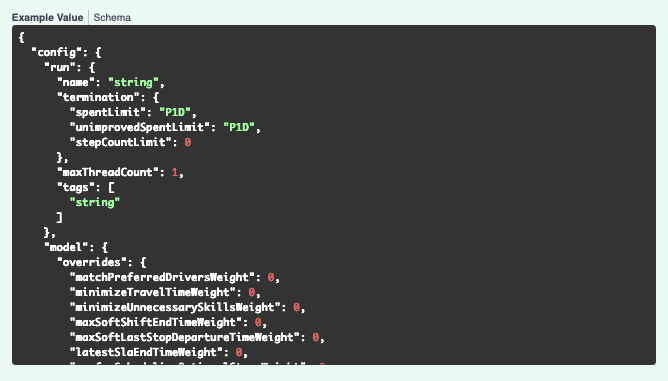
example values

The Schema tab shows the values, their types, and a description. Each field can be expanded to view related information.
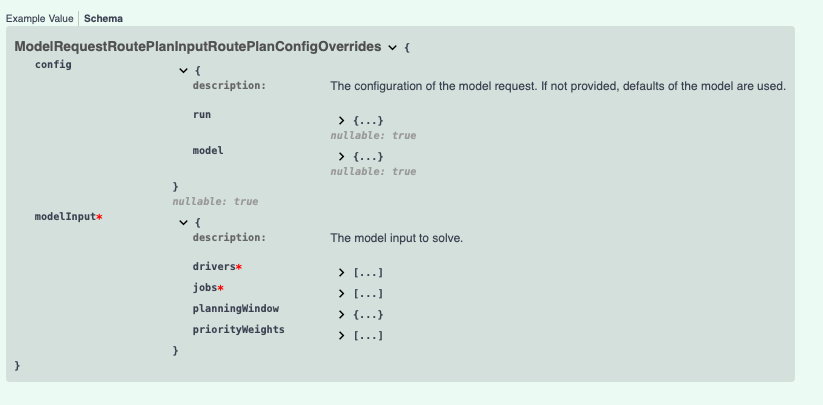
schema

Testing the Pick-up and Delivery Routing API

To test the Pick-up and Delivery Routing API in the platform, you first need to authorize.

  1. Via the Tenant drop-down in the top right, select Manage tenant.

  2. Navigate to the API Keys section.

  3. Create or copy an API key with Pick-up and Delivery Routing permissions.

  4. Navigate back to the Pick-up and Delivery Routing tile and select OpenAPI Spec.

  5. Click Authorize and paste the API key you just copied.

Learn more about using the Timefold API’s.

Demo datasets

Demo datasets that demonstrate the functionality are available. To view the list of demo datasets:

  1. Expand the POST /v1/demo-data endpoint.

  2. Click Try it out, then click Execute.

You will see the Curl instructions to request the dataset and the request URL.

You will also see the response to the request with the list of available datasets.

To download one of the listed datasets:

  1. Expand the POST /v1/demo-data/{demoDataId} endpoint.

  2. Click Try it out, enter the name of the dataset, for instance, "BASIC", and click Execute.

In the response body, you will see the dataset. Copy the dataset to use with subsequent endpoints.

You can also use your own dataset to test the functionality.

  • © 2026 Timefold BV
  • Timefold.ai
  • Documentation
  • Changelog
  • Send feedback
  • Privacy
  • Legal
    • Light mode
    • Dark mode
    • System default