Weekends worked per period
There are different techniques for managing employees' working hours.
For different scenarios see Work limits.
Weekends worked per period rules limit how many weekends employees can work in a period, for instance, if employees should only work one weekend throughout a period of one month.
Period rules for weekends can be defined for a month or the entire schedule.
This guide explains managing employees' hours with weekends worked per period:
Define weekends worked per period
Learn how to configure an API Key to run the examples in this guide:
In the examples, replace |
Period rules are defined in contracts:
{
  "contracts": [
    {
      "id": "fullTimeContract",
      "periodRules": [
        {
          "id": "Max1WeekendPerMonth",
          "period": "MONTH",
          "weekendsLimit":
          {
            "weekendsWorkedMax": 1
          },
          "satisfiability": "REQUIRED"
        }
      ]
    }
  ]
}
Period rules can define how many weekends employees work in a given period, for instance, one weekend per month.
PeriodRules must include an ID.
period sets the period the rule applies to, for instance, DAY, WEEK, MONTH, YEAR, SCHEDULE.
Further information about period:
DAY spans a single day and occurs every day in the schedule.
WEEK spans 7 days and occurs every week (including partial weeks) in the schedule.
The default start of the week is Monday, but this can be overridden to any day in the week:
{
  "scheduleParameterization": {
    "weekStart": "THURSDAY"
  }
}
MONTH spans the entire month.
MONTH has a variable number of days depending on the days in the month and occurs every calendar month (including partial months) in the schedule.
YEAR spans the entire year.
YEAR has a variable number of days depending on the days in the year, and occurs every calendar year (including partial years) in the schedule.
SCHEDULE spans the entire schedule.
| You can define custom periods to apply to this rule in the following way: |
{
  "scheduleParameterization": {
    "periods": [
      {
        "id": "PAY_PERIOD",
        "dateSpans": [
          {
            "start": "2023-01-01",
            "end": "2023-01-15"
          }
        ]
      }
    ]
  }
}
The start and end dates are inclusive.
weekendsLimit rules can only be defined for periods MONTH or SCHEDULE.
|
Learn about counting days in rules:
By default, rules count shifts within the defined period or rolling window if the shift starts within it. For instance, if you define a rule that an employee can only work one shift per day, a night shift that started on the previous day but ends the following morning will not be counted towards the limits specified in the rule.
To change this behavior, change the field periodShiftOverlapKind from START_ONLY to START_AND_END.
-
Period rule
-
Rolling-window rule
{
  "periodRules": [
    {
      "id": "Max8HoursPerDayFullTime",
      "period": "DAY",
      "minutesWorkedLimit": {
        "minutesWorkedMax": 480
      },
      "satisfiability": "REQUIRED",
      "periodShiftOverlapKind": "START_AND_END"
    }
  ]
}
{
"rollingWindowRules": [
{
"id": "Max8HoursPerDayRolling",
"rollingWindow": {
"type": "DAILY",
"size": 1
},
"minutesWorkedLimit": {
"minutesWorkedMax": 480
},
"satisfiability": "REQUIRED",
"periodShiftOverlapKind": "START_AND_END"
}
]
}This makes the rule count all parts of shifts that overlap with the defined period or rolling window. In the previous example, the night shift starts on the previous day and ends the following morning. With START_AND_END, the portion of the night shift that overlaps the target period or window is counted toward the rule.
The default behavior of all rules when this field is not specified is START_ONLY.
The weekendsLimit object must include weekendsWorkedMax with the maximum number of weekend worked per period.
Each employee must specify which contracts apply to them:
{
  "employees": [
    {
      "id": "Ann",
      "contracts": [
        "fullTimeContract"
      ]
    }
  ]
}
Filter shifts with tags
periodRules can include or exclude shifts based on tags.
{
  "contracts": [
    {
      "id": "fullTimeContract",
      "periodRules": [
        {
          "id": "Max1WeekendPerMonth",
          "period": "MONTH",
          "includeShiftTags": ["Part-time"],
          "shiftTagMatches": "ALL",
          "weekendsLimit":
          {
            "weekendsWorkedMax": 1
          },
          "satisfiability": "REQUIRED"
        }
      ]
    }
  ]
}
Further information about including or excluding shifts with shift tags:
Shifts with specific tags can be included or excluded by the rule. Tags are defined in shifts:
{
  "shifts": [
    {
      "id": "2027-02-01",
      "start": "2027-02-01T09:00:00Z",
      "end": "2027-02-01T17:00:00Z",
      "tags": ["Part-time"]
    }
  ]
}
Use includeShiftTags to include shifts with specific tags or excludeShiftTags to exclude shifts with specific tags.
shiftTagMatches can be set to ALL or ANY.
The default behavior for shiftTagMatches is ALL, and if omitted, the default ALL will be used.
The rule can define either includeShiftTags or excludeShiftTags, but not both.
{
  "includeShiftTags": ["Part-time", "Weekend"],
  "shiftTagMatches": "ALL"
}
With shiftTagMatches set to ALL, all tags defined by the rule’s includeShiftTags attribute must be present in the shift. With shiftTagMatches set to ANY, at least one tag defined by the rule’s includeShiftTags attribute must be present in the shift.
{
  "excludeShiftTags": ["Part-time", "Weekend"],
  "shiftTagMatches": "ALL"
}
With shiftTagMatches set to ALL, all tags defined by the rule’s excludeShiftTags attribute cannot be present in the shift.
This is useful when you want to exclude things in combination with each other.
For instance, excluding the shift tags Part-time and Weekend with shiftTagMatches set to All, will exclude shifts that include the tags Part-time and Weekend from the rule.
Shifts tagged only Part-time or only Weekend will not be excluded.
With shiftTagMatches set to ANY, any of the tags defined by the rule’s excludeShiftTags attribute cannot be present in the shift.
This is useful when you need to exclude tags regardless of their relationship to other tags.
For instance, excluding the shift tags Part-time and Weekend with shiftTagMatches set to ANY, will exclude any shift that includes the tags Part-time or Weekend, whether they occur together or not.
Configure weekend days
By default, weekends are Saturday and Sunday.
You can define different weekend days. Weekend days must be consecutive and have a maximum of three days and a minimum of one day.
Weekend days are configured in contracts:
{
  "contracts": [
    {
      "id": "fullTimeContract",
      "weekendConfiguration": {
        "weekendDays": [
          "FRIDAY",
          "SATURDAY"
        ]
      }
    }
  ]
}Required weekends worked per period
When the satisfiability of the rule is REQUIRED, the Weekends worked per period not in required range for employee hard constraint is invoked, which makes sure the number of weekends worked per period does not exceed the limit specified in weekendsWorkedMax.
Shifts will be left unassigned if assigning them would break the Weekends worked per period not in required range for employee constraint.
Required weekends worked per period example
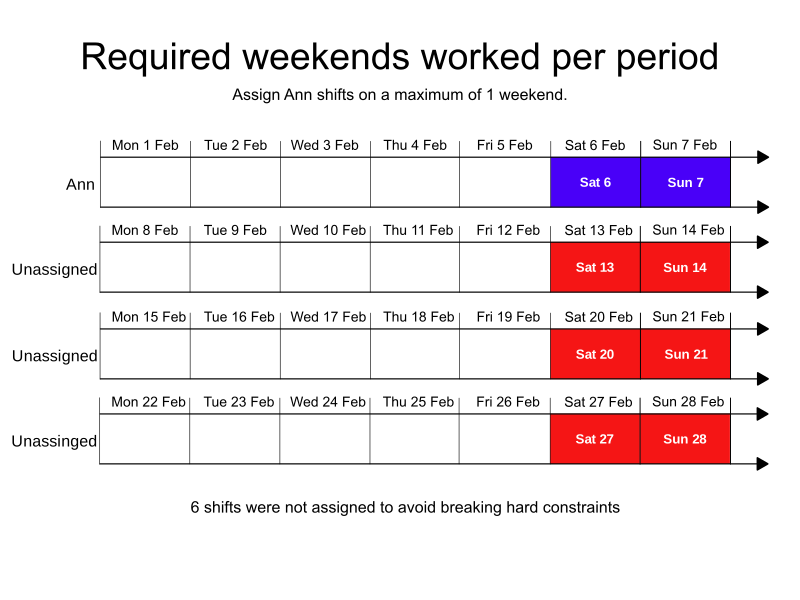
In the following example, there are eight shifts, one employee, and a rule with a required satisfiability that specifies the employee can work at most one weekend per month.
| Only the weekend shifts are shown in the example. |
Two shifts on one weekend are assigned and six shifts are left unassigned to avoid breaking the Weekends worked per period not in required range for employee hard constraint.
-
Input
-
Output
Try this example in Timefold Platform by saving this JSON into a file called sample.json and make the following API call:
|
curl -X POST -H "Content-type: application/json" -H 'X-API-KEY: <API_KEY>' https://app.timefold.ai/api/models/employee-scheduling/v1/schedules [email protected]{
"config": {
"run": {
"name": "Required weekends worked per period example"
}
},
"modelInput": {
"contracts": [
{
"id": "fullTimeContract",
"periodRules": [
{
"id": "Max1WeekendPerMonth",
"period": "MONTH",
"weekendsLimit":
{
"weekendsWorkedMax": 1
},
"satisfiability": "REQUIRED"
}
]
}
],
"employees": [
{
"id": "Ann",
"contracts": [
"fullTimeContract"
]
}
],
"shifts": [
{
"id": "Sat 6",
"start": "2027-02-06T09:00:00Z",
"end": "2027-02-06T17:00:00Z"
},
{
"id": "Sun 7",
"start": "2027-02-07T09:00:00Z",
"end": "2027-02-07T17:00:00Z"
},
{
"id": "Sat 13",
"start": "2027-02-13T09:00:00Z",
"end": "2027-02-13T17:00:00Z"
},
{
"id": "Sun 14",
"start": "2027-02-14T09:00:00Z",
"end": "2027-02-14T17:00:00Z"
},
{
"id": "Sat 20",
"start": "2027-02-20T09:00:00Z",
"end": "2027-02-20T17:00:00Z"
},
{
"id": "Sun 21",
"start": "2027-02-21T09:00:00Z",
"end": "2027-02-21T17:00:00Z"
},
{
"id": "Sat 27",
"start": "2027-02-27T09:00:00Z",
"end": "2027-02-27T17:00:00Z"
},
{
"id": "Sun 28",
"start": "2027-02-28T09:00:00Z",
"end": "2027-02-28T17:00:00Z"
}
]
}
}
To request the solution, locate the ID from the response to the post operation and append it to the following API call:
|
curl -X GET -H 'X-API-KEY: <API_KEY>' https://app.timefold.ai/api/models/employee-scheduling/v1/schedules/<ID>{
"metadata": {
"id": "ID",
"name": "Required weekends worked per period example",
"submitDateTime": "2025-06-13T05:45:08.168062776Z",
"startDateTime": "2025-06-13T05:45:26.111472225Z",
"activeDateTime": "2025-06-13T05:45:26.258624032Z",
"completeDateTime": "2025-06-13T05:45:57.168793571Z",
"shutdownDateTime": "2025-06-13T05:45:57.405050134Z",
"solverStatus": "SOLVING_COMPLETED",
"score": "0hard/-6medium/0soft",
"tags": [
"system.profile:default"
],
"validationResult": {
"summary": "OK"
}
},
"modelOutput": {
"shifts": [
{
"id": "Sat 6",
"employee": "Ann"
},
{
"id": "Sun 7",
"employee": "Ann"
},
{
"id": "Sat 13"
},
{
"id": "Sun 14"
},
{
"id": "Sat 20"
},
{
"id": "Sun 21"
},
{
"id": "Sat 27"
},
{
"id": "Sun 28"
}
]
},
"inputMetrics": {
"employees": 1,
"shifts": 8,
"pinnedShifts": 0
},
"kpis": {
"assignedShifts": 2,
"unassignedShifts": 6,
"disruptionPercentage": 0.0,
"activatedEmployees": 1,
"assignedMandatoryShifts": 2,
"assignedOptionalShifts": 0,
"travelDistance": 0
}
}Preferred weekends worked per period
When the satisfiability of the rule is PREFERRED, the Weekends worked per period not in preferred range for employee soft constraint is invoked.
{
  "contracts": [
    {
      "id": "fullTimeContract",
      "periodRules": [
        {
          "id": "Max1WeekendPerMonth",
          "period": "MONTH",
          "weekendsLimit":
          {
            "weekendsWorkedMax": 1
          },
          "satisfiability": "PREFERRED"
        }
      ]
    }
  ]
}
The Weekends worked per period not in preferred range for employee soft constraint is invoked when satisfiability is PREFERRED and the number of worked weekends in the period exceeds weekendsWorkedMax.
The constraint adds a soft penalty to the dataset score based on the number of weekends above weekendsWorkedMax, multiplied by the employee priority multiplier and the contract’s priority weight.
To ensure weekend-count constraints are comparable to time-based constraints, the penalty is also multiplied by 480 (an estimated average shift duration in minutes, used for normalization).
This normalization helps Timefold balance weekend limits against other scheduling preferences.
Shifts will still be assigned even if assigning them breaks this constraint.
|
Every soft constraint has a weight that can be configured to change the relative importance of the constraint compared to other constraints. Learn about constraint weights. |
| This rule is more likely to be satisfied for employees with a higher employee priority. See Employee priority for more details. |
Preferred weekends worked per period example
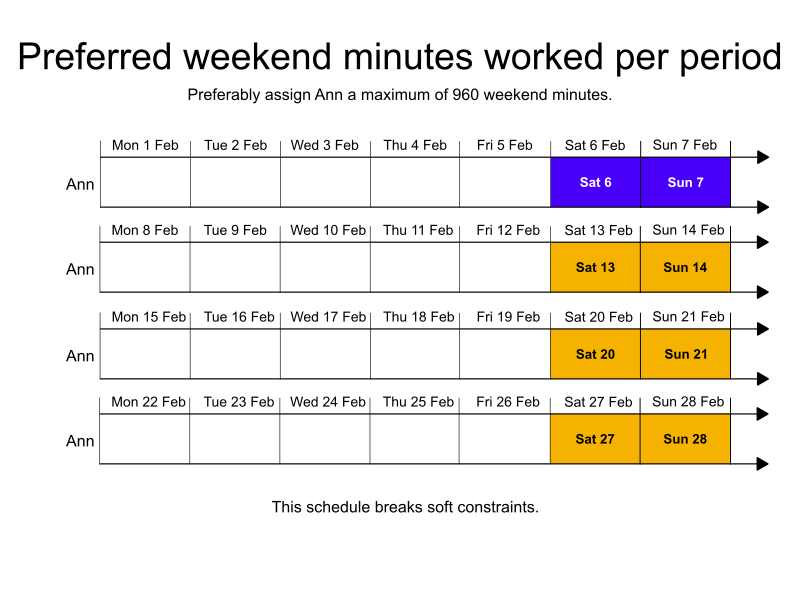
In the following example, there are eight shifts, one employee, and a rule with a preferred satisfiability that specifies the employee should work at most one weekend per month.
All eight shifts are assigned, and a soft penalty is applied to the dataset score.
-
Input
-
Output
Try this example in Timefold Platform by saving this JSON into a file called sample.json and make the following API call:
|
curl -X POST -H "Content-type: application/json" -H 'X-API-KEY: <API_KEY>' https://app.timefold.ai/api/models/employee-scheduling/v1/schedules [email protected]{
"config": {
"run": {
"name": "Preferred weekends worked per period example"
}
},
"modelInput": {
"contracts": [
{
"id": "fullTimeContract",
"periodRules": [
{
"id": "Max1WeekendPerMonth",
"period": "MONTH",
"weekendsLimit":
{
"weekendsWorkedMax": 1
},
"satisfiability": "PREFERRED"
}
]
}
],
"employees": [
{
"id": "Ann",
"contracts": [
"fullTimeContract"
]
}
],
"shifts": [
{
"id": "Sat 6",
"start": "2027-02-06T09:00:00Z",
"end": "2027-02-06T17:00:00Z"
},
{
"id": "Sun 7",
"start": "2027-02-07T09:00:00Z",
"end": "2027-02-07T17:00:00Z"
},
{
"id": "Sat 13",
"start": "2027-02-13T09:00:00Z",
"end": "2027-02-13T17:00:00Z"
},
{
"id": "Sun 14",
"start": "2027-02-14T09:00:00Z",
"end": "2027-02-14T17:00:00Z"
},
{
"id": "Sat 20",
"start": "2027-02-20T09:00:00Z",
"end": "2027-02-20T17:00:00Z"
},
{
"id": "Sun 21",
"start": "2027-02-21T09:00:00Z",
"end": "2027-02-21T17:00:00Z"
},
{
"id": "Sat 27",
"start": "2027-02-27T09:00:00Z",
"end": "2027-02-27T17:00:00Z"
},
{
"id": "Sun 28",
"start": "2027-02-28T09:00:00Z",
"end": "2027-02-28T17:00:00Z"
}
]
}
}
To request the solution, locate the ID from the response to the post operation and append it to the following API call:
|
curl -X GET -H 'X-API-KEY: <API_KEY>' https://app.timefold.ai/api/models/employee-scheduling/v1/schedules/<ID>{
"metadata": {
"id": "ID",
"name": "Preferred weekends worked per period example",
"submitDateTime": "2025-06-13T06:02:11.439168397Z",
"startDateTime": "2025-06-13T06:02:29.693348694Z",
"activeDateTime": "2025-06-13T06:02:29.876484365Z",
"completeDateTime": "2025-06-13T06:03:00.924300437Z",
"shutdownDateTime": "2025-06-13T06:03:01.193540069Z",
"solverStatus": "SOLVING_COMPLETED",
"score": "0hard/0medium/-2880soft",
"tags": [
"system.profile:default"
],
"validationResult": {
"summary": "OK"
}
},
"modelOutput": {
"shifts": [
{
"id": "Sat 6",
"employee": "Ann"
},
{
"id": "Sun 7",
"employee": "Ann"
},
{
"id": "Sat 13",
"employee": "Ann"
},
{
"id": "Sun 14",
"employee": "Ann"
},
{
"id": "Sat 20",
"employee": "Ann"
},
{
"id": "Sun 21",
"employee": "Ann"
},
{
"id": "Sat 27",
"employee": "Ann"
},
{
"id": "Sun 28",
"employee": "Ann"
}
]
},
"inputMetrics": {
"employees": 1,
"shifts": 8,
"pinnedShifts": 0
},
"kpis": {
"assignedShifts": 8,
"unassignedShifts": 0,
"disruptionPercentage": 0.0,
"activatedEmployees": 1,
"assignedMandatoryShifts": 8,
"assignedOptionalShifts": 0,
"travelDistance": 0
}
}Managing overtime
Rules with a satisfiability of REQUIRED put a hard limit on how much work employees can be assigned (minutes, hours, days, shifts), and doesn’t assign overtime.
A rule with a satisfiability of REQUIRED that states an employee can work a maximum of 1 weekends per period, will never assign the employee more than 1 weekends per period, even if assigning overtime would be beneficial to the overall schedule.
To allow for the possibility of overtime, use rules with a satisfiability of PREFERRED.
Set a rule with a PREFERRED satisfiability for the maximum number of weekends per period.
Now, a rule with a satisfiability of PREFERRED that states an employee can preferably work a maximum of 1 weekends per period will allow the employee to be assigned more weekends per period (overtime) than specified by the rule when it is necessary to do so.
To place a limit on the total amount of overtime employees can be assigned, include both:
-
A rule with
PREFERREDsatisfiability for the maximum number of weekends per period that is equivalent to the employees normal weekends per period. -
A rule with
REQUIREDsatisfiability for the maximum number of weekends per period (regular hours plus overtime).
The difference between the PREFERRED maximum weekends per period and REQUIRED maximum weekends per period is the total amount of overtime that can be assigned to employees.
Next
-
See the full API spec or try the online API.
-
Learn more about employee shift scheduling from our YouTube playlist.
-
See other options for managing employees' work hours: Work limits.